

Table of Contents
- Why Grounding Daily Matters for Your Nervous System
- The 5-4-3-2-1 Grounding Method: A Step-by-Step Tutorial
- Grounding Techniques for Anxiety You Can Use Anywhere
- How to Practice Mindfulness at Work Without Stepping Away
- Building a Daily Grounding Routine That Sticks
- Grounding Tools for Home: Creating a Calm Environment
- Conclusion: Your Next Step Toward Daily Grounding
- Frequently Asked Questions
Last Updated: September 16, 2026
Why Grounding Daily Matters for Your Nervous System
Grounding is deliberately bringing your attention to the present moment through your senses, breath, or physical body. Learning how to ground yourself daily is less about managing a crisis and more about building a baseline of steadiness.
The Physiology of Feeling Scattered
When your brain perceives a threat, your sympathetic nervous system triggers fight or flight: heart rate climbs, breathing goes shallow, and attention narrows onto the perceived danger. That system evolved for short bursts, not a full inbox.
The 5-4-3-2-1 Grounding Method: A Step-by-Step Tutorial
The 5-4-3-2-1 grounding method walks your attention through each of your five senses in descending order, pulling focus away from distressing thoughts and into your immediate environment. It works because sensory awareness is concrete; anxiety is abstract.
Here is how to run it:
- Name five things you can see. Look for specifics: the grain of a wooden desk, a chipped mug, the colour of a doorframe.
- Name four things you can feel. The weight of your feet on the floor, fabric against your arms, air on your face, the texture of a chair.
- Name three things you can hear. A fridge hum, traffic outside, your own breathing.
- Name two things you can smell. If nothing is obvious, move somewhere you can find a scent, or recall two you like.
- Name one thing you can taste. A sip of water, coffee residue, or simply the inside of your mouth.
How to Adapt the Method for Daily Practice
Running the full sequence once a day builds familiarity, but the real value comes from varying it: on a walk, swap the visual step for five textures underfoot; at your desk, use five sounds instead of five sights. The structure stays; the inputs change.
Grounding Techniques for Anxiety You Can Use Anywhere
Grounding techniques for anxiety work best when they are portable and discreet. If a technique needs a quiet room, a cushion, or a visible ritual, it will not be there at a supermarket checkout, in a meeting, or on a packed train.
Techniques You Can Run Without Anyone Noticing
- Temperature shift. Hold something cold, run cool water over your wrists, or press a chilled bottle against your neck. A sudden change in tactile sensation pulls attention into the body quickly.
- Feet-first scanning. Press both feet into the floor and trace the sensation from heel to toe, one foot at a time. This interoception, your sense of internal physical state, is one of the fastest routes out of overthinking, and it is invisible from the waist up.
- Object anchor. Choose one small item you always carry, such as a ring, a watch, or a key, and notice its weight and temperature whenever thoughts start spiralling. After a week or two, the object itself triggers the shift.
- Peripheral vision. Soften your gaze and take in what is at the edges of your vision rather than directly in front of you. This widens attention, the opposite of anxiety's tunnel vision, and can be done mid-conversation.
- Single-word labelling. Silently name the emotion in one word ("tight", "hot", "buzzing"), then one physical sensation in one word ("pressure", "cold"). Naming moves the experience from the emotional centre of the brain toward language-processing areas, reducing intensity (pubmed.ncbi.nlm.nih.gov).
Breathing Exercises for Anxiety
The most effective breathing pattern for anxiety has a longer exhale than inhale. Try inhaling for a count of four and exhaling for six to eight. Repeat for ten rounds.
healthdirect guide to breathing exercises for stress
Discreet Grounding for High-Pressure Work Environments
Most grounding advice assumes you can step away. In an open-plan office, a hospital ward, a classroom, or a client-facing role, you often cannot. These techniques run in under sixty seconds without a visible break.
- The desk anchor. Rest both feet flat on the floor and press down for a slow count of five, then release. Repeat three times. From outside it looks like thinking.
- The keyboard pause. Before replying to a message that raised your heart rate, type nothing for one full breath. The pause is invisible and interrupts the automatic reply you would otherwise regret.
- The doorway reset. Every time you walk through a doorway, take one slow breath and feel your feet meet the floor. Doorways are natural transition points most people pass dozens of times a day.
- The hand-wash anchor. Washing your hands is a socially acceptable reason to leave a room for twenty seconds. Use the water's temperature and the sensation of your hands as the anchor rather than rehearsing the conversation ahead.
- The pre-meeting minute. Arrive at your seat sixty seconds early and use that minute for three slow exhales rather than checking your phone. This is the highest-leverage habit for people whose anxiety peaks in meetings.
When to Use Which Technique
A simple rule: use a physical technique (temperature, feet, object) when thoughts are loud and fast, and a breathing technique when your body is activated but your mind is relatively clear. If unsure, start with the feet, which works in both.
How to Practice Mindfulness at Work Without Stepping Away
Mindfulness at work does not require a meditation room, just thirty to sixty seconds of deliberate attention, repeated.
Building a Daily Grounding Routine That Sticks
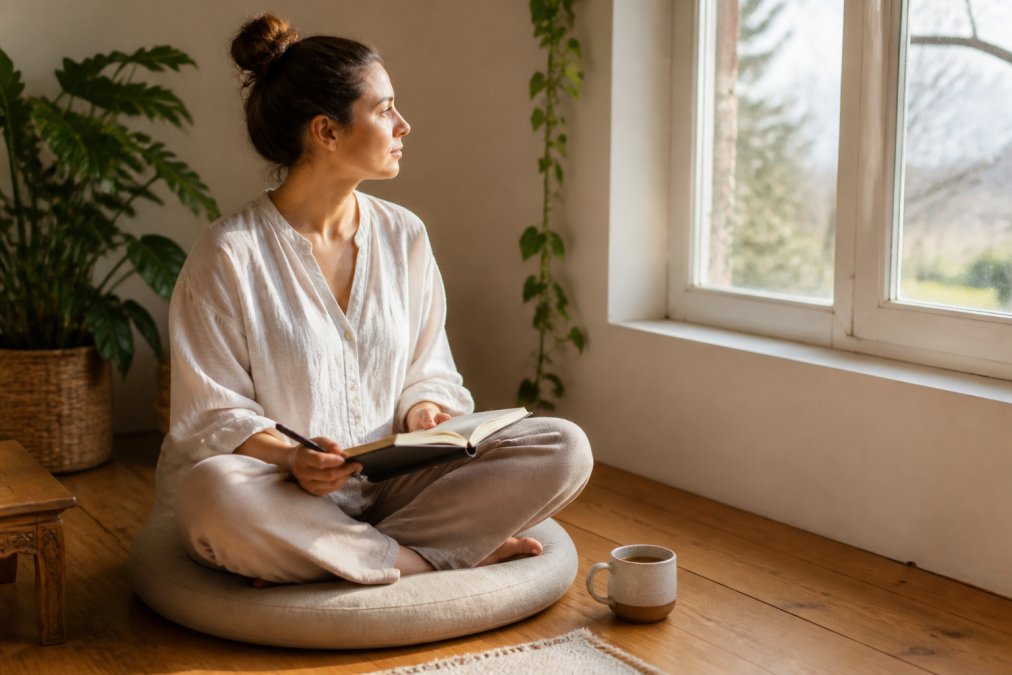
Most grounding content stops at the technique. The harder problem is building a daily practice still running in three months, not three days. That is a behaviour-design problem, not a relaxation problem.
Why Most Routines Collapse in Week Two
A common pattern: the first week feels good, the second feels like a chore, and by the third the practice has quietly disappeared. Three forces drive that collapse, each with a counter-move.
- The motivation dip. Novelty carries the first week. Once it fades, habit must carry the practice rather than enthusiasm. Counter-move: make the practice so small it does not require motivation. Three breaths counts.
- The rigidity trap. A routine that only works at 6am on a cushion breaks the first time you travel, get sick, or sleep badly. Counter-move: define a minimum viable version (one minute, anywhere, no equipment) alongside the full version.
- The all-or-nothing reset. Missing one day feels like failure, so people abandon the whole system. Counter-move: a missed day is skipped, not repeated, and the streak you protect is weekly, not daily.
The Habit-Anchoring Method
The most reliable way to make a new practice stick is to attach it to something you already do without thinking. Behavioural researchers call this habit stacking; the existing behaviour acts as a free reminder.
- Anchor: "After I pour my morning coffee..."
- Practice: "...I take three slow breaths before the first sip."
- Reward: the coffee itself, now associated with the pause.
Morning Grounding Rituals
Start with the body before the mind: three minutes of slow breathing before checking your phone, then write down one intention for the day.
Evening Reflection and Intention Setting
Evening practice closes the loop. Spend two minutes noting what pulled you away from the present moment and what brought you back. Adding gratitude, such as writing down one thing that went well, reinforces the habit.
How to Know It Is Working
Grounding is not a switch, and early progress is easy to miss. Most practitioners find the first change is not fewer anxious moments but a shorter recovery time: you notice the spiral sooner and have a technique ready before it takes hold.
Grounding Tools for Home: Creating a Calm Environment
Grounding tools for home work by removing friction. If your practice requires assembling a space each time, you will skip it. If the space is already there, you will use it.
| Element | Purpose | Where It Helps Most |
|---|---|---|
| Seating cushion | Comfortable, stable posture | Morning and evening sits |
| Journal with prompts | Structured reflection | Intention setting, gratitude |
| One sensory object | Visual or tactile anchor | Mid-day resets |
| Water bottle | Hydration and temperature anchor | Workplace grounding |
The environment does not create the habit, but it removes the excuses. A cushion left out and a journal left open are reminders that cost you nothing and get used.
Conclusion: Your Next Step Toward Daily Grounding
The hardest part of grounding is not learning the techniques but remembering to use them on an ordinary Tuesday when nothing is on fire. The people who succeed treat it as a small daily practice rather than an emergency tool.
ReachOut Australia on grounding techniques for anxiety
Frequently Asked Questions
What is the 3-3-3 rule for grounding?
The 3-3-3 rule is a quick grounding technique that asks you to name three things you can see, three sounds you can hear, and three body parts you can feel. It works by redirecting your attention from distressing thoughts to your immediate sensory environment. You can do it anywhere, and it takes less than a minute. It is a simpler alternative to the 5-4-3-2-1 method when you need something fast.
How long should I ground myself every day?
Consistency matters more than duration. Five to ten minutes of intentional grounding each day builds the habit and trains your nervous system to settle more quickly over time. If you are new to grounding, start with two minutes in the morning and two minutes in the evening. You can extend sessions once the routine feels natural. The goal is regular practice, not long sessions.
Can grounding techniques help with physical symptoms of anxiety?
Yes. Grounding techniques for anxiety can ease physical symptoms like a racing heart, shallow breathing, and muscle tension by activating the parasympathetic nervous system. Slow, intentional breathing and sensory awareness interrupt the fight or flight response. While grounding is not a replacement for medical treatment, it is a practical tool you can use alongside other support. If physical symptoms persist, speak with a healthcare professional.
How do I know if I need to ground myself?
Common signs include feeling detached from your surroundings, racing thoughts, irritability, shallow breathing, or tension in your jaw and shoulders. You might also notice difficulty focusing or a sense of being overwhelmed by small tasks. When these signals appear, a short grounding practice can help you reset. Over time, you will learn to recognise your own early warning signs and respond before stress escalates.
0 comments